Enhancing Conversational AI for E-Commerce with Bottom-Up Synthesis
Enhancing Conversational AI for E-Commerce with Bottom-Up Synthesis
Kun Qian¹, Maximillian Chen¹, Siyan Li¹, Arpit Sharma², Zhou Yu¹³
1: Columbia University 2: Walmart 3: Arklex.ai
Introduction
Building high-quality conversational AI systems requires vast amounts of domain-specific training data. However, collecting real-world task-oriented dialogues can be challenging due to data scarcity and privacy concerns. Traditional methods rely on a top-down approach, where large language models (LLMs) generate entire conversations from a broad prompt. While this method ensures fluency, it lacks control over finer details, leading to inaccuracies or hallucinations.
To address these challenges, researchers have introduced Bottom-Up Conversation Synthesis (BUSY)—a novel framework that constructs realistic task-oriented dialogues by first generating question-answer (QA) pairs and then assembling them into a coherent conversation. This bottom-up methodology offers improved control, factual accuracy, and privacy compliance, making it particularly valuable for knowledge-grounded applications like e-commerce chatbots.
In this article, we explore how the BUSY framework is revolutionizing synthetic dialogue generation, with a focus on its application to the Walmart Shopping Companion dataset.
Limitations of Traditional Top-Down Dialogue Generation
The conventional approach to generating synthetic conversations follows a top-down methodology:
- A high-level prompt is provided to an LLM.
- The model generates a multi-turn dialogue in a single pass.
- The resulting conversation is used for training chatbots.
While this method is effective in producing fluent interactions, it has notable limitations:
- Lack of Granularity: A single broad prompt cannot enforce fine-grained control over each turn in the conversation.
- Hallucinations: The model may generate incorrect or irrelevant information, especially when external knowledge is required.
- Privacy Concerns: When dealing with proprietary databases, non-local models require access to confidential data, raising security issues.
To overcome these shortcomings, the BUSY framework takes a bottom-up approach, ensuring higher-quality dialogues with greater control.
Bottom-Up Conversation Synthesis (BUSY) Explained
BUSY follows a structured, stepwise process to generate task-oriented and knowledge-grounded conversations. Instead of synthesizing an entire dialogue in one go, it first generates question-answer pairs and then constructs full conversations by linking them logically.
Step 1: Question Generation
BUSY begins by generating realistic customer questions in three phases:
- Extracting Attributes: The model analyzes real user questions and product databases to identify key attributes (e.g., product specifications, features, pricing).
- Iterative Refinement: LLMs generate questions based on extracted attributes, and prompts are refined over multiple iterations to improve realism.
- Validation: The generated questions are compared against human-written queries to ensure alignment.
💡 Example: Instead of prompting an LLM to generate an entire conversation about a vacuum cleaner, BUSY first generates focused questions like:
- “What is the battery life of this vacuum?”
- “Is this model suitable for cleaning pet hair?”
Step 2: Answer Generation
Once the questions are created, answers are generated using a structured database rather than relying on free-text generation. This ensures factual correctness and prevents hallucinations.
- Answers are strictly retrieved from a verified product knowledge base.
- If an answer is unavailable, the model responds with a predefined template (e.g., “I’m sorry, this information is not provided. Do you want to contact the provider?”).
- All answers are generated locally to protect data privacy.
💡 Example:
Q: Does this vacuum come with a HEPA filter?
A: Yes, this model includes a HEPA-certified filter for allergen control.
Step 3: Connecting QA Pairs into Conversations
With high-quality QA pairs in place, the final step is to stitch them together into full-fledged dialogues:
- A virtual assistant persona is added to maintain natural flow.
- Opening, closing, and transition turns are inserted to create a seamless conversation.
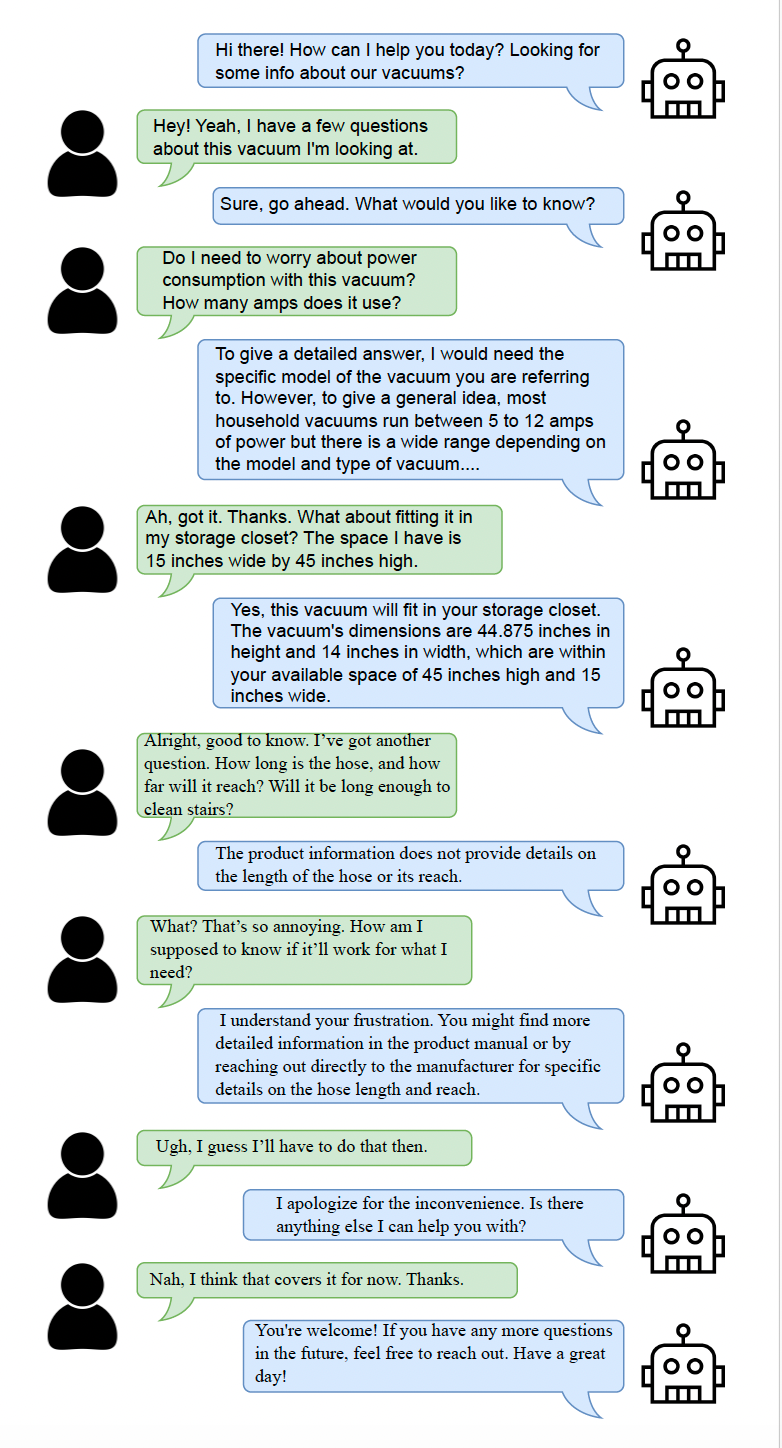
- Dialogues include realistic user behaviors, such as frustration when information is missing.
💡 Example Dialogue Snippet:
Evaluating BUSY: How Does It Perform?
To validate BUSY, the researchers generated 6,000 dialogues for various e-commerce categories (e.g., vacuums, diapers, clothing). Both human evaluators and LLMs were used to assess dialogue quality.
Key Findings
- Higher Truthfulness: Since answers are database-grounded, hallucinations are significantly reduced.
- Improved User Experience: Conversations are more structured and informative compared to traditional top-down approaches.
- Better Control & Adaptability: Iterative prompt refinement allows fine-tuning of generated data, leading to more natural and domain-specific interactions.
Comparison with Top-Down Generation:
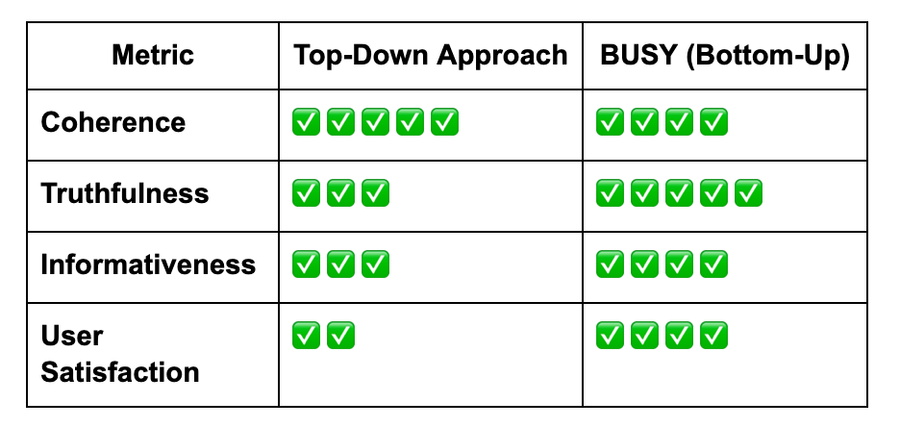
Takeaway: BUSY offers a more realistic, controllable, and privacy-friendly approach to dialogue generation.
Real-World Applications of BUSY
BUSY is particularly useful for knowledge-grounded applications, including:
- E-Commerce Assistants 🛒 (e.g., Walmart Shopping Companion)
- Customer Support Chatbots 💬 (handling FAQs with factual responses)
- Healthcare AI Assistants 🏥 (providing evidence-based medical guidance)
- Technical Support Bots 🔧 (offering precise troubleshooting steps)
By ensuring fact-based responses, BUSY enhances the reliability and trustworthiness of AI-powered assistants.
Conclusion & Future Directions
The BUSY framework represents a major leap forward in synthetic dialogue generation. By shifting from top-down to bottom-up synthesis, it delivers higher accuracy, better control, and improved privacy.
What’s next?
- Expanding BUSY beyond e-commerce to healthcare, finance, and education.
- Enhancing context awareness to handle long-form multi-turn conversations.
- Integrating reinforcement learning to fine-tune dialogue coherence.
As AI-powered assistants continue to evolve, bottom-up synthesis could become the new standard for generating factually grounded and user-friendly conversations.
Try it out and give our open-source project a star:
https://github.com/arklexai/Agent-First-Organization