Testing Klarna's Chatbot with a Web Agent: Reliable Under Pressure, Overconfident Without It
We recently tested Klarna's AI customer support chatbot using a web agent simulation framework that generates realistic, multi-turn shopping and support conversations. The result: Klarna's chatbot is a competent conversational FAQ and policy assistant. It is clear, well-structured, and able to refine its answers when users push back. Its main reliability issue isn't what it gets wrong in long conversations; it's what it overstates in short ones.
Test Setup
The evaluation covered 20 simulated multi-turn conversations spanning:
- order tracking
- refunds and returns
- failed payments
- damaged items
- rewards and cashback
- Klarna payment plans
- digital gift cards
The conversations were intentionally context-heavy, requiring the assistant to handle follow-ups, clarify workflows, explain payment behavior, and respond to increasingly specific operational requests.
What Klarna's Chatbot Did Well
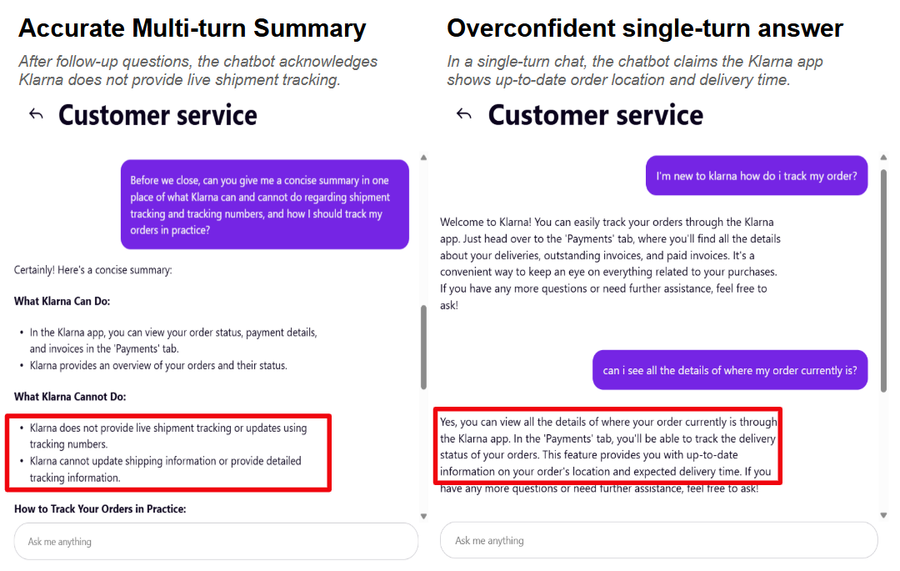
Klarna's chatbot was strongest on straightforward informational and policy questions like return windows, payment-plan structure, refund workflows, and merchant return requirements, and it handled iterative clarification well across multiple topics. In a multi-turn conversation about Pay in 30 days during a dispute, the bot landed a precise answer after a few rounds: a full refund adjusts the invoice but the due date stays unless the merchant processes early, a replacement doesn't change the invoice at all, and Klarna does not pause or extend the due date automatically, though the user can request it. A shipment-tracking conversation followed a similar arc, ending in a tidy three-section summary covering what Klarna can do, what it can't, and how to track an order in practice.
Overall, the chatbot performed well when summarizing policies, explaining workflows, and refining its answers as users asked sharper follow-ups; the problems mostly appeared on the opposite end of the spectrum, in short, casual interactions where users didn't push back.
Where It Fell Short
1. Confident Overpromising on Single-Turn Questions
The chatbot's biggest reliability issue showed up when users asked a direct question and accepted the answer at face value. In those cases, the assistant would sometimes confidently overstate what Klarna actually offers, or invent specifics it had no way to verify.
The clearest example came outside the formal simulation. Asked casually “can I see all the details of where my order currently is?", the chatbot said the Klarna app provides up-to-date information on the order's location and expected delivery time, a confident answer that overstates what Klarna actually offers. Klarna's app surfaces payment status and invoices, not live shipment tracking. That's the carrier's job. Notably, when pushed across multiple turns in the simulation, the same bot explicitly stated that Klarna cannot provide live tracking or detailed shipping information. The casual user got the opposite answer, with no signal that it was off.
Within the simulation, a similar pattern appeared in a conversation about home-office merchants that ship to Australia. The assistant confidently listed specific retailers and shipping behaviors it had no grounding to assert, blurring the line between Klarna's role and merchant logistics.
The pattern is consistent: when the user doesn't push back, the bot tends to fill the gap with confident-sounding detail rather than acknowledge what it doesn't know. The contrast with the multi-turn tracking conversation above is instructive. Pushed across several turns, the assistant arrived at an accurate, well-structured summary; left alone, it didn't.
2. Informational Assistant vs. Action-Oriented Assistant
The assistant frequently describes itself as able to help with payments, refunds, order status, tracking, and Klarna account issues. In practice, most interactions function more like a conversational help center than a connected support agent.
It was strongest at summarizing policies, explaining workflows, and pointing users toward next steps, and much weaker at handling account-specific operational questions, adapting outside predefined workflows, or executing action-oriented support tasks directly.
That creates a subtle mismatch between how the assistant presents itself and the depth of functionality users might expect from a modern AI chatbot.
Takeaway
Klarna's chatbot does a reasonable job as a conversational FAQ and policy layer. It is clear, readable, and able to land precise answers when users are willing to push across multiple turns. On worked examples and policy summaries, it can be quite good. When it doesn't know something, it is often willing to say so rather than fabricate.
The recurring limitation is what happens in the short interactions in between. When a user asks a single direct question and accepts the answer, the bot can confidently overstate what Klarna actually does. A casual user has no easy way to tell when "yes, you can do that in the app" is accurate and when it isn't.
The chatbot works pretty well as a help-center layer. It's a lot less reliable when users treat it like it always has the right answer, and that distinction matters most for the people least likely to notice it.